
Origin & research
From an unexplained cluster of fevers to a fully sequenced genome: the story of how GPV-1 was identified.
Meet GPV-1
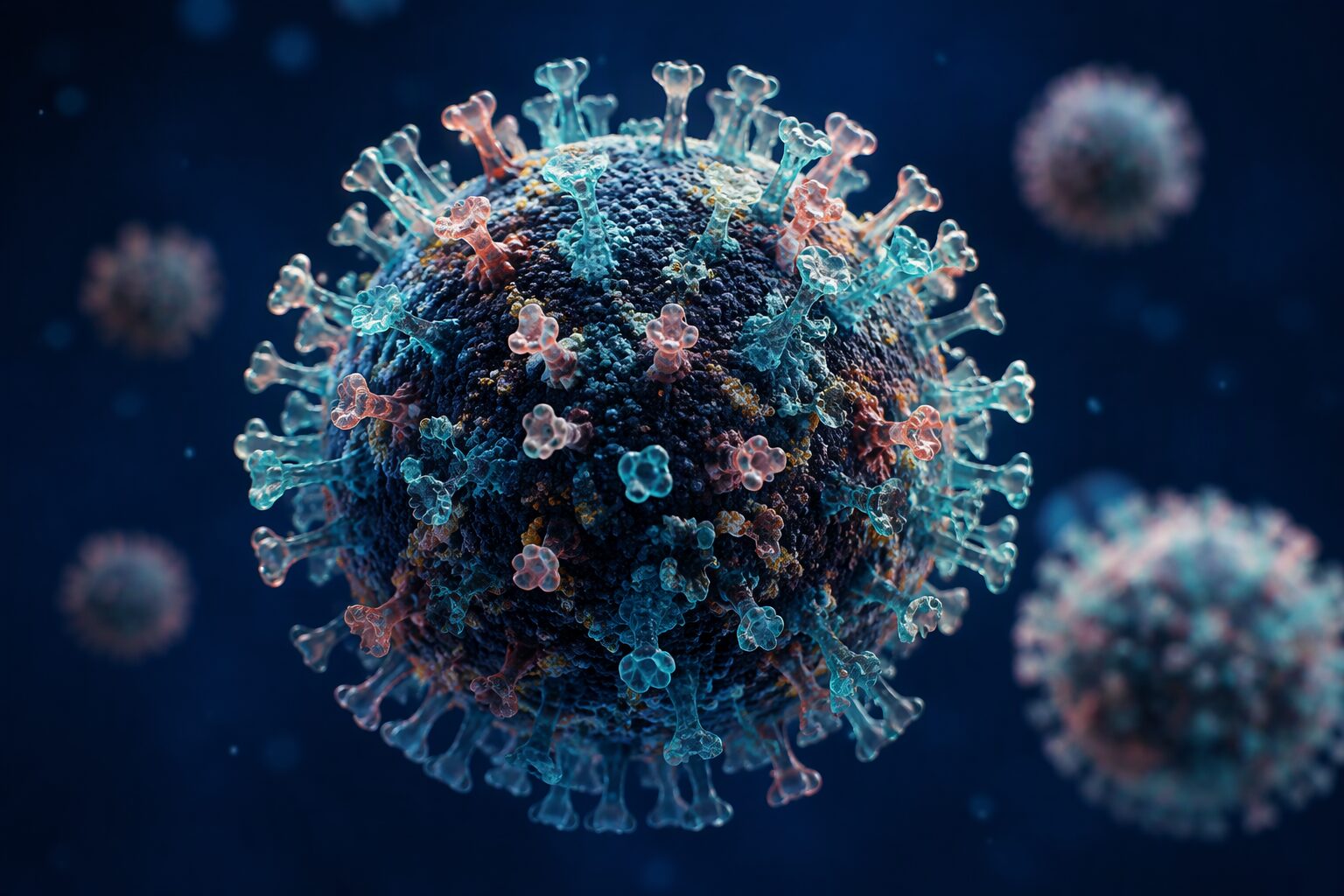
Glue Piel virus is an enveloped, single-stranded RNA virus roughly 110–130 nanometers across. It has been provisionally placed in a new family, Adhesoviridae, genus Viscovirus.1
Its most striking feature is the G-coat: a dense layer of glycoproteins with unusually strong adhesive properties. The G-coat helps virus particles bind to cells, and to almost everything else, which explains GPV-1's long survival on surfaces.2 It is also easily disrupted by soap and detergents.
Researchers believe the same G-coat proteins, shed during fever, contribute to the “tacky skin” sign seen in many patients.
How it was identified
- Late August 2026
An unusual cluster
Urgent care clinics in western Travis County, Texas, note an uptick in patients with abrupt fever, vomiting, and severe aches that test negative for influenza, COVID-19, and norovirus.
- September 2026
Index specimen collected
A respiratory sample from the first identified patient is designated GPV/TX/HB-001/20263 and sent for advanced testing.
- October 2026
Genome sequenced
Metagenomic sequencing reveals a novel RNA virus with no close relatives. Electron microscopy shows the distinctive fuzzy, adhesive coat.
- November 2026
“Glue Piel” adopted
The working name, coined by clinicians for the virus's sticky coat and tacky-skin sign, is formally adopted for public communication.

Open research questions
- Is there an animal reservoir, and if so, which species?
- How long does immunity last after infection?
- Why does the G-coat favor some surfaces (metal, fiberglass) over others?
- Can G-coat proteins serve as a vaccine target?
The Center for Adhesive Virology is coordinating specimen sharing and genomic surveillance across participating laboratories.

- Okafor-Lind M, Brandt J, et al. Proposal for a new family, Adhesoviridae, to accommodate Glue Piel virus. J Fict Virol. 2026;4(11):201–214.
- Haskins R, Tran P. Surface persistence of GPV-1 on common household and marine materials. Adhesive Pathogens Quarterly. 2026;2(3):55–61.
- Specimen names follow the convention virus/state/locality-sequence/year. TX = Texas; HB = Hudson Bend, Austin, TX, place of residence of the first identified patient.